

The Gratitude Equation
Balancing Appreciation, Boundaries, and What Truly Sustains Us

November is National Gratitude Month, a reminder that we can turn our attention toward what’s good in our lives and invest our time and energy in ways that help us feel better. It’s a time when we can take a few extra minutes out of our day to acknowledge and appreciate the people, experiences, and things that help us bring joy, connection, and meaning to our lives. When we actively practice gratitude, good things tend to follow, such that it can strengthen our wellbeing, deepen our relationships with the people we care about, and help us see life through a more generous and hopeful lens.
And just so you know, practicing gratitude is backed by science, showing that we can literally rewire our brains to see the world in a less negative light, interrupting the mind’s default setting, which is the negativity bias. The negativity bias refers to the brain’s habit of giving more weight to negative experiences than positive ones. Gratitude can help interrupt that loop, helping us to experience life as more balanced and, in turn, feel calmer and more at peace with ourselves. We can use this time to pause and look a little closer at what’s already good in the day we’re living. That kind of awareness, when paired with time and energy, can help us better understand how to participate in experiences that both create and sustain our gratitude. This interplay between awareness, physiology, and emotion is part of The Wellbeing Equation in action—how the mind and body reinforce one another.
As the holidays approach, we can find ourselves moving too fast, juggling competing expectations and trying to stay grateful while also feeling the stress of work, family, and the emotional fatigue that often comes with managing it all. For example, we want to feel thankful, but our schedules can become so full that our minds grow busy and overcrowded, and our energy can get pulled in too many competing directions. When this happens, even practicing gratitude can start to feel less like something we do willingly and more like another obligation on an already packed to-do list, one that can drain the peace and thankfulness we all want to feel this time of year.
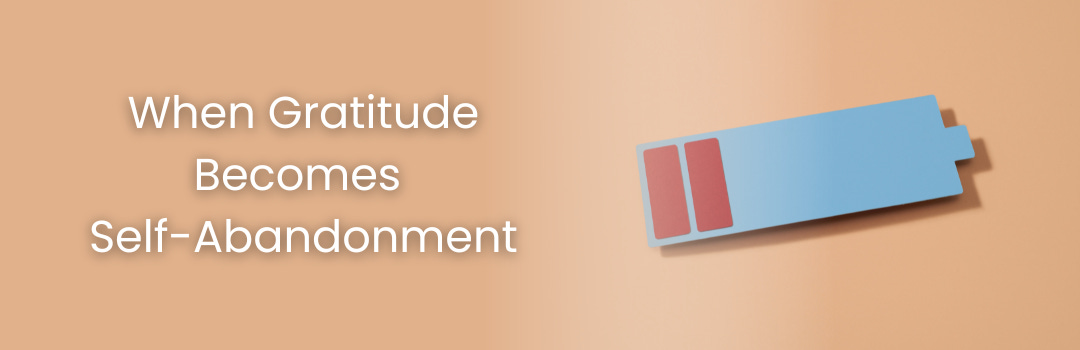
Culturally, many of us have been taught that gratitude should come easily—that good people, like us, are grateful no matter what. But gratitude, when it’s genuine, asks something deeper of us than cheerful positivity with a constant smile on our face. It asks us to explore what actually helps us feel better, particularly when we’re struggling. It takes both effort and awareness, the willingness to keep exploring new ways of living and adjusting how we move through our days. When we skip that kind of honesty, gratitude can turn into a kind of self-abandonment, giving thanks outwardly while inwardly feeling empty and anything but grateful for our own emotional experience.
One patient put it this way. Each year, as soon as October turned to November, she could feel the weight of the holiday season tighten through her body. Her shoulders would stiffen, she began sleeping less soundly, and her mind started spinning through lists of tasks: coordinating travel, cooking meals, buying gifts weeks before the holidays even began, and making family plans. Everyone around her saw her as the capable, responsible one, the person who held it all together while everyone else felt stressed and anxious. And she believed it as well, until her stress heightened, eventually turning into fatigue, then resentment, and her gratitude felt anything but genuine.
In our sessions, we began tracing where this pattern of overextending herself at the expense of her own needs began. Growing up, she was the emotional anchor in a household that prized keeping the peace over being open and honest. Her mother would often say, in an overly saccharin tone, “Let’s keep things nice,” particularly when tension filled the room.
Gratitude became a kind of peacekeeping ritual, a way to keep love intact, but at the cost of swallowing her own frustration until it made her ill, and she couldn’t bear it anymore. As she grew up, she carried this pattern of gratitude with her, thanking others even when she didn’t feel it, and smoothing over potential conflict before anyone else noticed it existed. What looked like kindness on the outside was, underneath, a lifelong rehearsal in keeping love alive by disappearing into the role of the delightful little helper.
When she finally began to notice how tired she felt, how the very holiday season that was supposed to bring warmth and connection left her instead feeling drained and more connected to her exhaustion, we decided to help her experiment a bit. As she worked through the guilt that often turned inward as self-criticism, learning to meet herself with a bit more compassion became a way to help her feel more genuine gratitude. Instead of hosting the full family gathering and carrying all its accompanying responsibilities, she asked her siblings if they’d be willing to pitch in and share some of the load. She also allowed herself to buy store-made pies rather than bake from scratch, a holiday tradition she’d long been known for.
Most importantly, she began asking herself if there were things she didn’t want to take on before automatically and “cheerfully” saying yes when she didn’t mean it. At first, she felt awkwardly giddy, almost as if she were enjoying a necessary act of disobedience—and in her own way, she was. But gradually, over time, she began to open space for herself and realized she wasn’t doing anything wrong.
When she began saying no thoughtfully, she noticed that the guilt which once overtook her so easily began to lessen a bit. At first, saying no felt awkward, almost wrong, but over time she noticed something shift; she could say yes when she actually meant it, not just to hold everything together. Gratitude, she realized, wasn’t about pleasing everyone; it was more about showing up in a way that felt right for her.

For this patient, her emotional life and her sense of connection to herself began to change when she stopped living as though she had to put her needs last to be loved. When she continued to keep the peace at her own expense, she ended up feeling numb, resentful, and cut off from anything resembling gratitude. It was only when she began honoring her limits and making choices that supported her wellbeing that she began to feel positive emotions about herself. Gratitude came not from shallow expressions of pleasing others but from finally figuring out what she needed and taking steps to attend to those needs, something she could, at last, feel genuinely thankful for.
For some of us, gratitude cannot be experienced when we’re depleted and exhausted. For others, when all hope feels lost, gratitude is the very thing we reach for to bring some comfort in the midst of life’s turmoil. Either way, gratitude points to what we try to remain connected to when we are struggling or when we want to keep what matters most to us in the forefront of our minds. It can reveal where our care and attention should go if we want to stay connected to what is good for us and help us feel more alive.
In terms of gratitude, this is where boundaries and self-care enter the picture. Boundaries can allow us the space to pause and ask ourselves what we need before we overextend ourselves. And self-care, when it’s genuinely good for us, can help us use that space to restore our strength and energy. When we’re able to do this, gratitude can change from something we try to merely feel into something that grows naturally out of how we live our lives.
The balance between appreciation, boundaries, and what is good for us is the foundational heart of the Gratitude Equation. Gratitude, in this sense, becomes a way of exploring how we care for ourselves, gaining perspective on what helps us restore our balance and sense of self, and practicing the awareness that helps us bring our wellbeing into existence.
The Gratitude Equation describes the conditions that make genuine gratitude possible. It isn’t a formula but a relationship: when awareness, healthy boundaries, and self-care interact, they cultivate the inner capacity for real appreciation—the ground that supports our wellbeing.
For some, the idea of setting boundaries can carry an old echo of rejection or selfishness. When we begin to protect our own needs, it can stir up an old conflict between caring for ourselves and the belief that love means putting others first.
Psychoanalytically, guilt can arise when the wish to care for ourselves comes into conflict with the demand to care for others at the expense of our own wellbeing. Some of us can fear that setting healthy boundaries—that saying no—will lead to love being withdrawn or replaced with disappointment. Yet boundaries are often what make genuine care possible. They can help us stay connected to ourselves and to others in ways that feel honest rather than forced. When we can experience and notice this, guilt can begin to lessen over time. We stand a chance of seeing that saying no doesn’t have to be a rejection of others, but a way of preserving the kind of relationships that can actually last.
When we start setting limits, it can take us time to adjust. We’ve often spent years putting our needs last, so learning to listen to ourselves can feel uncomfortable at first. Our body will often let us know how we’re doing. This can show up through tension, stress, or the sense that we’ve been running on empty. It can also tell us when we’re finding our footing—when we notice less fatigue, a bit more hope, or an energy that feels more our own.
Our body has its own way of letting us know when we’ve gone past the point of what feels right for us and when we’re coming back into balance in healthy ways. The work isn’t to push past those signs—like tension, fatigue, irritability, or that sense we’re running on empty—and call it gratitude, but to pay attention to what they’re telling us about our wellbeing. We can start to restore a sense of cooperation with ourselves. From this more grounded space, gratitude isn’t something we have to chase or force, causing us more exhaustion. It’s something that can begin to take shape more naturally, in relation to how we live and care for ourselves day by day.
As the work with my patient continued, she found that her holidays began to feel lighter and more enjoyable. She still cared deeply for her family, but she no longer measured her worth by how much she took on or gave at her own expense. She began to feel more grounded—more herself in a way that felt right—and, paradoxically, more appreciative. The less she pushed herself to prove her worth through doing, the more space she had to actually feel thankful for what was already there. What she noticed was that her sense of gratitude grew not from doing more, but from allowing herself to do less and to care for herself more along the way. Gratitude became less about proving her love to others and more about appreciating how much better she could feel when she put healthy boundaries in place.
What happened for my patient shows how gratitude can easily get tangled up with old patterns of trying to prove ourselves. Many of us learn early on that love or approval depends on how much we give, so we carry that belief into adulthood. When we’re worn out, we tell ourselves we should be thankful we have a job, a family, a home—when what we’d actually feel thankful for is an afternoon by ourselves to rest, a meal we don’t have to prepare, or a day when more isn’t asked of us. In this way, we use gratitude as a way to talk ourselves out of our own needs and what would make us actually feel grateful.
Our society often prizes busyness and generosity at the expense of the very self-care required to make genuine appreciation possible. The byproduct of this way of going about life is often a kind of burnout, wrapped in the language of gratitude and what we “should be grateful for.” For us to stand a chance of living differently, we have to see gratitude not as a demand to stay positive, but as a way of staying connected to the practices that support our health and wellbeing, and to the experiences that we actually feel grateful for.
Notice When Gratitude Turns Into Obligation
When you catch yourself saying yes a bit too often, especially out of guilt or duty, try to stop and pause before you respond. Ask yourself what’s behind your yes. Is it a genuine wish to give, or more an attempt to manage an expectation or your guilt? A brief moment of honesty can often reveal whether your choice comes from a sense of willingness or from pressure you’d rather avoid. The difference often becomes clear afterward, in whether you feel grounded and content, or resentful and a touch more depleted.
Let Gratitude Include the Hard Parts
Gratitude doesn’t mean ignoring what’s painful. When we try to be thankful while pushing aside our frustration or exhaustion, it can start to feel forced. Instead, we can let both exist—the parts of life that bring us joy and the parts that bring us pain.
Sometimes that looks like feeling grateful for the love still present in our lives while also feeling sad for the loss of someone we miss, or appreciating a brief moment of rest when we feel tired and worn down.
When we can hold both, gratitude becomes less about pretending and more about being real with ourselves—about noticing what’s still good even when life doesn’t feel easy.
Recenter in the Present Moment
When the pace of life speeds up — too many things coming at me, too many items on my to-do list, I notice how quickly I can leave the moment I’m in and become anxious or irritable. Sometimes my right eye even starts to twitch as I get caught up trying to fix an imagined scenario or solve a problem that doesn’t really exist in the way I’m picturing it. Before I know it, I’m already a few steps ahead of myself, moving toward a moment that hasn’t even arrived.
When this happens, I try to slow my mind down and give myself an extra minute to breathe—not to check out, but to check in with myself and my surroundings. I look for something specific to help ground me in the moment: the sound of my own breathing, the light shining through the window after the clouds break, the voice of someone I care about from across the room. Sometimes I even sit down and remind myself out loud, hey, slow it down, Bronce—it’s okay, you’re just anxious. You’ve been through worse.
For me, gratitude can begin here, not in some far-off place I’m dreaming of, but in what’s real and still right in front of me. In a strange way, that awareness helps me stay with myself and hold things together in ways that feel real and I can be thankful for. Even when life is hard, that ability, though sometimes shaky, feels like something I can still be grateful for—an everyday reminder of how wellbeing is built in moments, not ideals.
When we can return to what’s present within us or around us, even for brief moments—especially when we’re struggling—we give ourselves the chance to interrupt that constant urgency to chase a better version of the moment we’re already in. If we can practice small ways of returning to ourselves, over time we begin to build a different kind of stability—the kind that allows gratitude to take root and become part of our daily experience. Not as an idea, but as a felt sense that life is happening now, and we’re in it, even when it’s not everything we want it to be. To be grateful for what we have—right now and actually feel it. Bronce, you’re enough for me in this very moment. Thank you. I’m grateful for your guiding presence, and for the love and compassion you’re learning to cultivate.
Reflection Questions
🧠 When I feel pressure to be grateful, what fear or expectation contributes to it?
🧠 How does my body tell me when I’ve crossed from genuine giving into over-giving?
🧠 What boundary, if I could find a way to put it in place and honor it, would help me feel more grateful in this present moment?

🗓 November 14 | 2:00 PM EST | Substack — LIVE: Writing, Healing, and the Lost Art of Gratitude
Join me and Amanda Saint, founder of The Mindful Writer, for a conversation on writing as a healing practice. We’ll explore how gratitude shapes the stories we tell about our lives—and how slowing down to write mindfully can reconnect us to presence, compassion, and meaning.
Amanda brings her background as a novelist, teacher, and creator of The Slow Writing Movement, along with new insights from her ongoing mindfulness training with Tara Brach and Jack Kornfield.
You can find out more about Amanda and her Substack work HERE.
Do yourself a favor and sign up for her newsletter. It’s a great way to increase your sense of Gratitude in this very moment!
This Live session invites reflection, gentle inquiry, and shared conversation about how words can help us live with more gratitude and a deeper sense of wholeness.
In Closing
National Gratitude Month reminds us that our wellbeing is not measured by how much we give, but by how meaningfully we connect—to ourselves, to others, and to what sustains life within us. Gratitude without capacity is a candle burning at both ends. But when we pair appreciation with self-awareness, gratitude becomes a renewable resource; it helps to restore us instead of draining us. Perhaps the greatest renewable energy source we humans have at our disposal—in this very moment!
This season, may our gratitude include our limits, our needs, and our right to rest and linger a bit longer in the midst of what is truly good for us.
👇 Comment below:
What’s one small way you could honor your capacity this month while still practicing gratitude?
With love, compassion, and hopefully a fair amount of steadiness,
—Bronce
👉 If you’d like to read more about me and my Wellbeing Equation journey, please visit my website: www.broncerice.com and my Substack About Page.
👉 And if you like what you’ve read, please sign up for my newsletter The Wellbeing Equation HERE and spread the word by hitting the restack button ♻️ to share with your community.
👉 I also offer Paid Subscribers access to additional resources and deeper content related to your wellbeing. You can sign up HERE.
I aim to stay in gratitude as much as possible. It’s not always easy when I am busy or when something is annoying or worrying me. So, I remind myself to be grateful for everything that comes to me and all that I give out. The ideal, although hard to remember, is to be grateful for even the things that go wrong, because they bring their own lessons. I think of gratitude as a way of living, rather than a list to recite, although that at least is something. This, of course is what you are doing by including gratitude in your Wellbeing Equation. A great read, thank you Bronce 💕
Bronce, this really puts words to why “forced gratitude” can feel so heavy instead of healing. I appreciate how you link thankfulness to boundaries and the permission to rest. It’s a good nudge to ask what I’m truly grateful for, and whether I’m actually giving myself space to feel it.